
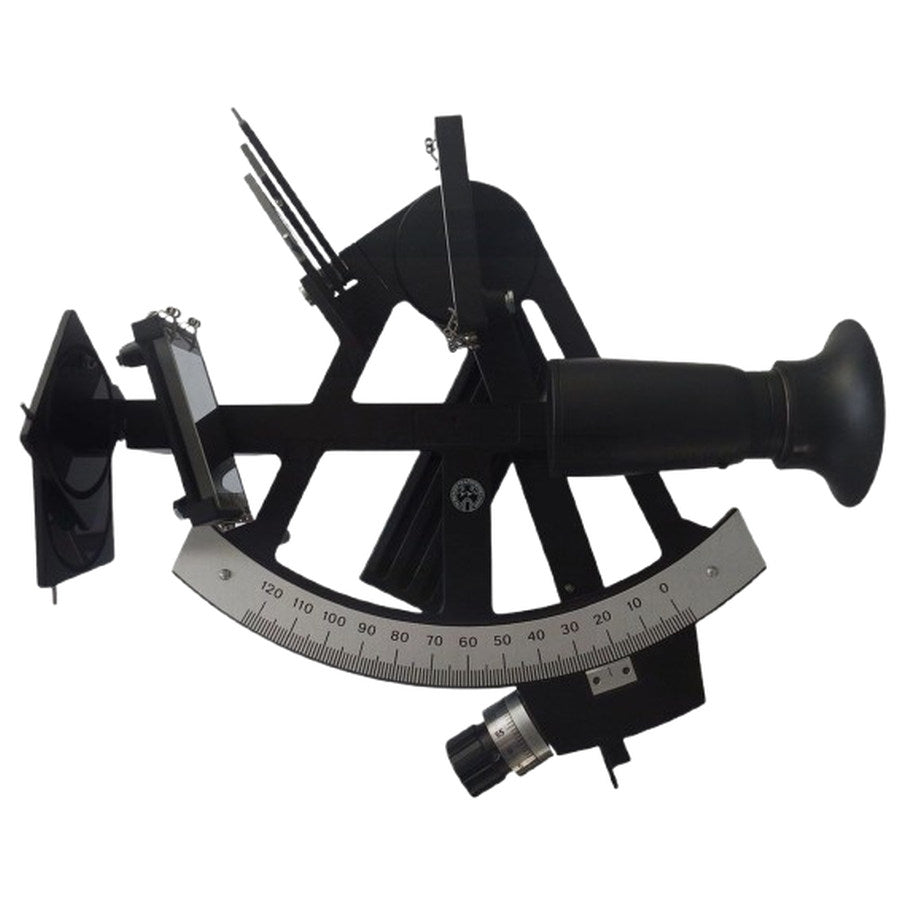
Despite the widespread use of GPS and electronic charting systems, the nautical sextant remains one of the most respected and reliable navigation instruments created. For centuries, sailors crossed oceans using celestial navigation techniques, relying on a marine sextant, an accurate clock, and a thorough understanding of the sun, stars, and planets to work out their position at sea. Even today, many professional mariners and offshore sailors continue learning celestial navigation as a backup skill should electronic systems let them down.
Understanding how to use a sextant for navigation is about much more than simply measuring angles. It requires knowledge of celestial bodies, observation techniques, correction calculations, and navigation principles that have guided mariners across oceans for generations. In this guide, we'll explain exactly how to use a sextant, how to take accurate celestial observations, and how those observations are transformed into a position on a nautical chart.
What Is a Sextant?
A sextant is a precision optical instrument designed to measure the angle between two visible objects. In celestial navigation, it is most commonly used to measure the altitude of a celestial body above the horizon. The altitude is simply the angle between the visible horizon and an object such as the sun, moon, star, or planet.
The marine sextant consists of several key components, including the frame, telescope, index arm, horizon mirror, index mirror, arc and vernier scales, and micrometer drum. These components work together through a system of double reflection, allowing navigators to make accurate angular measurements, often to within a fraction of a minute of arc.
The index arm is a movable arm that moves along the graduated arc and adjusts the position of the reflected celestial body. The horizon mirror, which is partially silvered, allows the navigator to view both the horizon directly and the reflected image of the celestial body simultaneously through the telescope.
While modern navigation technology offers instant position fixes, a sextant requires no batteries, no satellite signal, and no external power source. This reliability is one reason why many commercial vessels are still required to carry working sextants as part of their navigation equipment.
Understanding the Principles of Celestial Navigation
Before learning how to use a sextant, it helps to understand the principles behind celestial navigation.
Every celestial body appears directly above a specific point on the Earth's surface known as its geographical position. By measuring the altitude of a celestial body above the horizon line and recording the exact time of the observation, a navigator can calculate their distance from that geographical position.
The process combines sextant observations with information from the Nautical Almanac, sight reduction tables, and an accurate clock or marine chronometer. The calculations allow navigators to establish lines of position which can be plotted on a chart.
Two important concepts used throughout celestial navigation are altitude and azimuth. Altitude refers to the height of a celestial body above the horizon, while azimuth describes its direction measured along the horizon from true north. Together, these measurements help determine a vessel's position and orientation.
Modern celestial navigation calculations also use data such as Greenwich Hour Angle (GHA) and declination to identify the precise location of celestial bodies at any given moment.
Preparing the Sextant Before Taking a Sight
The first step when learning how to use a sextant is ensuring the instrument is properly adjusted. Even a small error can significantly affect the final position calculation, so fine adjustments may be required.
The most common adjustment is checking for index error. Index error occurs when the sextant does not read exactly zero when the horizon and its reflected image are perfectly aligned.
To check the index error, set the index arm to zero and look through the telescope at a clear horizon. If the direct horizon and reflected horizon form a perfectly straight line, the sextant is correctly adjusted. If they appear offset, the amount of difference is measured and recorded as the index error.
This correction must be applied to every observation made with the instrument. Experienced navigators routinely check index error before every set of sights to ensure accuracy.
In addition to checking the index error, inspect the horizon mirror, telescope, shades, and moving parts to ensure everything is functioning correctly. Clean optics and smooth movement of the index arm are essential for reliable observations.
Taking a Sun Sight with a Sextant
For beginners, the sun is usually the easiest celestial body to observe. Daytime observations provide an excellent introduction to most sextant operation and celestial navigation principles.
Begin by fitting the appropriate shade glasses to protect your eyes. Never look directly at the sun's altitude through a sextant without using the correct sun filters.
Stand on stable ground if practising ashore, or find the most stable position possible aboard a vessel. Hold the sextant vertically using the handle and look through the telescope towards the horizon.
Using the index arm, slowly bring the reflected image of the sun into view. Continue adjusting until the lower edge of the sun appears to touch the visible horizon. This technique is known as bringing the sun down to the horizon.
At this point, gently rock the sextant from side to side. The sun will appear to trace a shallow arc. The correct reading occurs when the lowest point of the sun's arc just touches the horizon. This ensures the sextant is perfectly vertical and eliminates errors caused by tilt.
The moment the sun touches the horizon, record the exact time using an accurate clock. Precise timing is really important because celestial bodies move continuously across the sky. Even a small timing error can result in a significant position error.
Most navigators take several observations in quick succession and average the results to improve accuracy.
Why Accurate Time Is Essential
Many beginners underestimate the importance of timing when learning how to use a sextant.
The Earth rotates 15 degrees every hour, meaning celestial positions change constantly. The exact time of an observation is required to determine where the observed celestial body was located above the Earth at that moment.
Navigators used a marine chronometer to maintain accurate Greenwich Mean Time. Today, modern technology, such as a GPS-synchronised clock or high-quality quartz watch, may serve the same purpose when practising celestial navigation.
The recorded time works alongside data from the Nautical Almanac, including the Greenwich Hour Angle and declination of the observed body, allowing accurate calculations of position.
Applying Sextant Corrections
The raw sextant reading, known as Sextant Altitude (Hs), cannot be used directly. Several corrections must be applied before obtaining the Observed Altitude (Ho).
The first standard correction is the index error identified during instrument setup. This compensates for any mechanical or optical misalignment.
Next comes dip correction. Because an observer's eye is located above sea level, the visible horizon appears slightly lower than the true horizontal line. Dip correction accounts for this effect and varies according to the observer's eye height.
Atmospheric refraction also affects observations. Light bends as it passes through the atmosphere, causing celestial bodies to appear slightly higher than their true position. Atmospheric refraction corrections are therefore discarded from observations.
When observing the sun or moon, semi-diameter correction is applied. Since these bodies appear as discs rather than points, navigators usually measure either the lower limb or the upper limb. Semi-diameter correction adjusts the observation to the centre of the celestial body.
These corrections transform the sextant altitude into a true observed altitude suitable for navigation calculations.
Measuring Other Celestial Bodies
Although the sun is the most common object used by beginners, sextants can also measure stars, planets, and the moon at night time.
Observations of other celestial bodies are often conducted during nautical twilight, when both the horizon and stars remain visible. Star sights can provide highly accurate position fixes because stars appear as points rather than discs, excluding the need for semi-diameter correction.
Planetary observations follow similar principles, although navigators must identify the correct celestial body before taking the sight.
Using multiple celestial bodies allows navigators to create intersecting lines of position, producing a highly accurate fix.
Learning to identify stars and planets is an important part of advanced celestial navigation and expands the capabilities of the sextant beyond simple daytime observations.
Understanding Noon Sight Navigation
One of the oldest and most practical sextant techniques is the noon sight.
A noon sight occurs when the sun reaches its highest altitude in the sky during Local Apparent Noon. At this moment, the sun crosses the observer's meridian and reaches its maximum altitude for the day.
By carefully observing the sun's highest point and applying the necessary corrections, navigators can determine latitude accurately.
Before electronic navigation systems existed, noon sights formed the backbone of ocean navigation. Sailors would often combine a noon sight with dead reckoning calculations to maintain an accurate estimate of their position throughout a journey.
Practising noon sights remains one of the best ways to develop confidence when learning celestial navigation.
Common Mistakes When Using a Sextant
Like any precision instrument, the sextant requires practice to master. One of the most common mistakes is failing to check the index error before taking observations.
Another frequent problem is poor timing. Without an accurate clock, even a perfectly measured altitude can produce inaccurate results.
Many beginners also struggle with maintaining a clear view of the horizon, especially in rough seas. Taking observations from a higher position above sea level often improves horizon visibility and accuracy.
Improper use of the telescope, incorrect rocking technique, and failing to apply corrections such as dip correction, atmospheric refraction, and semi-diameter correction can also introduce significant errors.
The key to success is consistent practice. Taking regular observations and comparing results helps build confidence and accuracy over time.
Why Learning Celestial Navigation Still Matters
Despite today being dominated by electronic navigation systems, some sailors question whether learning celestial navigation is still worthwhile.
GPS systems can fail, batteries can die, and electronic equipment can be damaged. A sextant, Nautical Almanac, and accurate clock provide an independent means of navigation.
As well as practical value, celestial navigation develops a good understanding of geography, astronomy, and traditional seamanship.
For offshore cruisers, ocean racers, and professional mariners alike, understanding how to use a sextant remains one of the most beneficial navigation skills to learn.
Buy Sextants and Navigation Equipment from Seamark Nunn
Whether you're taking your first steps into celestial navigation or replacing existing navigation equipment, having reliable tools is essential.
At Seamark Nunn, you'll find a carefully selected range of marine sextants, navigation instruments, nautical books, charts, and essential accessories to support your journey into traditional navigation. With decades of experience supplying sailors, yacht owners, and marine professionals, Seamark Nunn offers trusted products, expert advice, and competitive pricing.
If you're serious about learning how to use a sextant for navigation, contact Seamark Nunn for expert advice.