Few things slow a boat down faster than a season’s worth of slime, barnacles and stubborn marine hitchhikers. One haul-out can reveal a hull so furry it looks like it belongs in a wildlife documentary.
That’s when reality hits: it’s time to antifoul. And the next question arrives just as quickly:
“How much is this going to cost me?”
The truth is, the price varies more than many boat owners expect, so here’s a clear breakdown of what you’ll actually pay, and why.

The short answer: what antifouling really costs
Before we dig into the details, here’s the quick snapshot most boat owners, especially new boat owners, want.
Antifouling prices can swing quite a bit depending on your boat, the yard, and how much prep work is needed, but these ranges will give you a real-world sense of what you’re in for.
Small boats (20–25 ft)
Perfectly manageable… until you see how fast they can gather growth.
-
DIY antifouling: £120–£250
Enough for paint, rollers, sandpaper and tape, ideal if you don’t mind getting blue splatters everywhere. -
Professional job: £400–£700
Haul-out, wash, labour and materials wrapped into one neat (ish) bill.
Medium boats (26–35 ft)
The sweet spot for many cruisers, and where costs start to climb with surface area.
-
DIY: £180–£350
One or two coats, depending on how fussy you are about a perfect finish. -
Professional: £500–£900
Expect the price to increase if the yard hits flaking patches or stubborn old paint.
Larger boats (36–45 ft+)
Bigger hull, bigger responsibility… and yes, a bigger budget.
-
DIY: £250–£450+
You’ll need more paint, and likely more coffee. -
Professional: £700–£1,200+
Labour and lift-out costs make the biggest dent here, especially if prep work is needed.
What actually affects the cost of antifouling for boat owners?
There’s no single “standard” price for antifouling, and that’s exactly why quotes sometimes feel like they were pulled out of thin air. But once you understand the real factors behind the cost, everything suddenly becomes a lot more predictable (and a lot less stressful).
Let’s break down the biggest one first.
1. Boat size and hull shape
This is the deal-breaker. The more hull you’ve got below the waterline, the more time, paint and effort it’s going to take, simple as that.
Think of it like painting a wall:
- A 20-ft hull? Manageable.
- A 35-ft cruiser with deep bilge keels? Now we’re talking time, technique and a very long afternoon.
- A catamaran? Double the hulls, double the fun… and double the paint bill.
Every extra curve, keel, chine or underwater nook adds work. Labour goes up, paint use goes up, and so does the final invoice.
The good news is you can estimate paint pretty accurately. Most antifoul paints cover roughly 9–10 m² per litre when applied by brush or roller, so once you know your boat’s wetted surface area (and you factor in your coats), you can get a solid handle on quantities. As a rule of thumb, one 2.5L tin is typically enough for two coats on a small sailing yacht up to about 25ft, while a typical 36ft sailing yacht may need around three 2.5L tins.
2. Condition of the existing antifoul
This is where costs can swing wildly, because what’s already on your hull can seriously affect what you’ll pay next.
If your current antifoul is in good shape and simply needs a fresh coat, you’re in the “quick job, easy life” category. But if things look a little… chaotic… that’s when the price climbs.
Here’s what sends the costs upward:
-
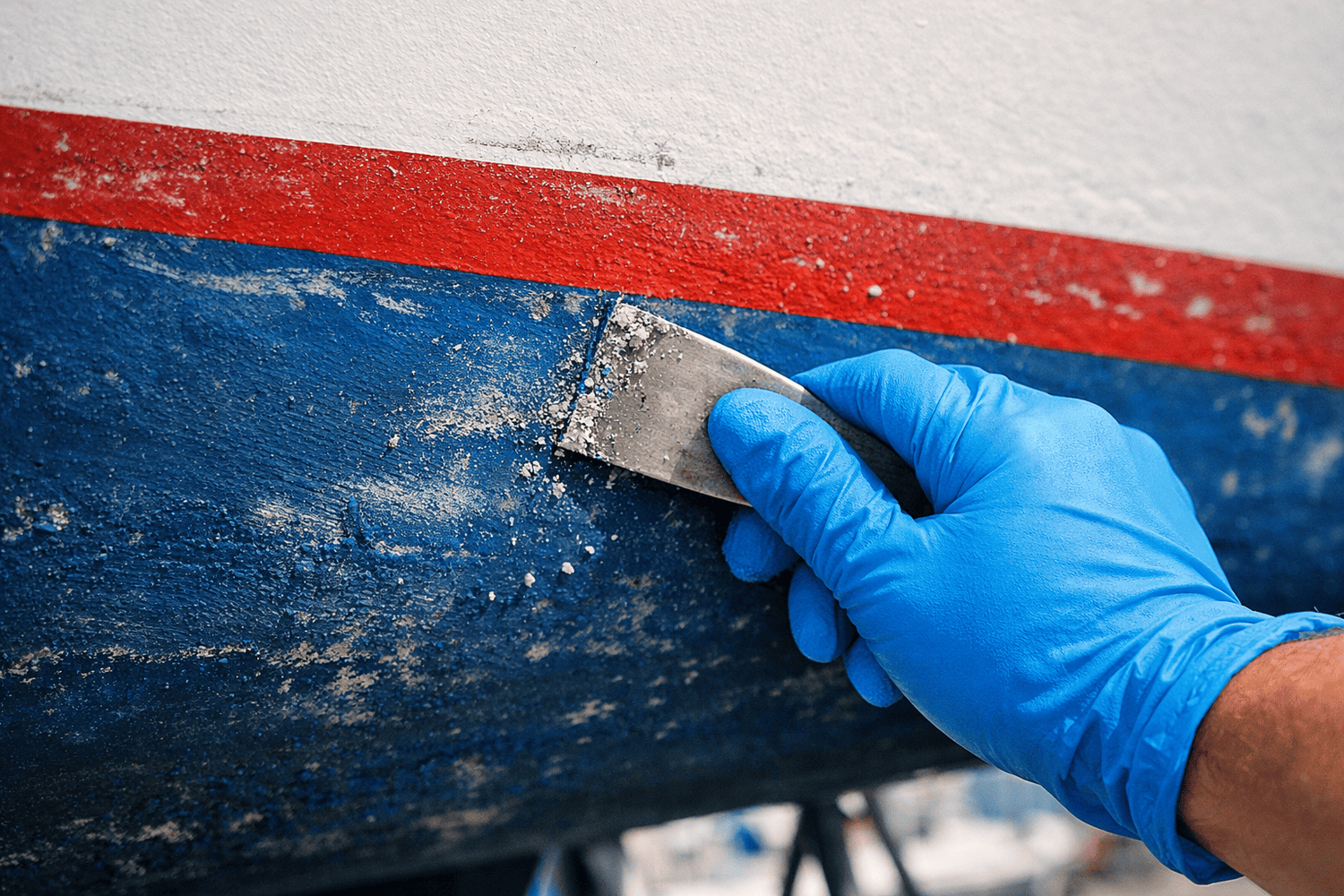
Flaking or peeling patches
These need scraping, sanding or smoothing before any new paint can go on. No yard wants the paint applied to sit on a surface that will fall off a month later. -
Blisters, bare patches or dings
These spots often need priming or extra attention, especially if the gel coat is exposed, to make sure the new coat actually sticks. -
A season’s worth of heavy fouling
Barnacles, slime and marine gunk don’t just slow your boat down; they add a lot of labour time during prep.
In short:
A hull that just needs a quick pressure wash + one tidy coat = one price.
A hull that needs hours of prep before the paint even comes out of the tin = a very different price.
3. Type and amount of antifouling paint
Here’s where costs can quietly creep up, because not all antifouling paints behave (or cost) the same. Think of it like choosing fuel: they’ll all get you going, but some perform better, last longer, or suit specific conditions.
Type of antifoul
Different paints = different prices and performance:
Hard antifoul
Best suited to fast powerboats, where you need a tougher coating that stays put rather than wearing away. Racing owners often favour systems such as VC system antifouling paint, which can be burnished to create an ultra-smooth finish.
Self-polishing / eroding antifoul
Generally, the better choice is for slower boats such as sailing yachts. It gradually wears away in use, continually exposing fresh biocide and keeping protection consistent. As with most antifouls, it’s typically reapplied each year.Popular examples include Hempel antifoul, International antifoul, and Seajet antifouling paint, each offering different performance levels depending on fouling conditions and cruising plans.
Premium or specialised antifoul
Usually comes with a higher price tag, but is designed for specific conditions (for example, high-fouling areas or particular hull materials). Even then, antifoul is generally intended to last one season, so it’s still normally an annual job.
Specialist coatings
Certain areas of your boat may require more targeted protection. For example, transducer antifouling paint is formulated so it won’t interfere with depth sounder signals, while outboard & sterndrive antifouling is designed specifically for aluminium legs and underwater metals. Smaller fittings such as props, shafts and trim tabs may benefit from flag antifoul, which is easy to apply to awkward shapes. Owners of RIBs and tenders should also look at inflatable boat antifoul, formulated for PVC or Hypalon tubes rather than traditional GRP hulls.
Number of coats
This part really affects the total. As a rule, you should always aim for two full coats of antifoul to ensure proper coverage and season-long protection. If you still have paint left after the second coat, it’s worth applying a third coat just below the waterline, as this area is more exposed to UV light and tends to foul faster.
The equation is simple:
More coats = more paint = more labour = more cost.
4. DIY vs professional application
This is where the cost can change dramatically, because how you choose to antifoul your boat matters almost as much as the boat itself.
Let’s break it down.
DIY antifouling: what you’ll actually spend
Rolling up your sleeves and doing it yourself can save a chunk of money, especially if your boat is already on a trailer or stored ashore. Your main expenses look like this:
- Antifouling paint (you should budget for two full coats)
- Underwater primer if you’re applying onto bare GRP (e.g. Primocon)
- Rollers, trays and brushes
- Masking tape
- Sandpaper and basic protective gear
That’s it. No labour cost, no waiting for yard availability, no surprises.
And the best part? You’re in full control, including:
- How well the hull is prepped
- How thickly you apply the paint
- How many coats you use
- Which brand or type of antifoul you choose
A lot of boat owners choose this hybrid approach, pay the yard for the lift and pressure wash, then do the painting themselves. It keeps costs sensible without sacrificing quality.
Professional antifouling: what’s included?
If you’d rather hand the job over to the experts (or you don’t have the time/space to DIY), here’s what a professional antifoul usually covers:
- Lift-out and relaunch
- Pressure washing the hull
- Time ashore in the yard
- Labour for prep, masking and application
- Paint and materials
This is why yard quotes can look high at first glance — the price reflects the full service, from haul-out to application, not just the final coat of paint.
Before booking, it’s always smart to ask what’s actually included:
- Is the paint included, or do you supply your own?
- Is the pressure wash part of the price?
- Is extra prep charged separately?
- Does the quote include one coat or two?
Clear answers = no surprises on the invoice.
5. Location and yard rates
Here’s a factor many boat owners don’t think about until the quotes start rolling in: your yard’s pricing structure can change everything.
Two yards, same boat, same job, and you can still end up with completely different totals. Why? Because each yard has its own costs to cover, and those costs filter straight down into your bill.
Different yards will charge differently for things like:
-
Hourly labour rates
- Some yards have highly skilled teams and higher labour costs; others keep things more budget-friendly.
-
Lift-out or crane fees
- This alone can swing the price, especially for larger boats.
-
Storage ashore
- A week on the hard might be included… or it might not.
-
Environmental disposal fees
- Old antifoul scrapings, contaminated water, and waste paint all require proper handling, and some yards charge separately for it.
So don’t be surprised if quotes vary more than you expected, it’s not necessarily the job that changes, it’s the yard cost, overheads and demand.
Example cost breakdowns
Here are a few real-world scenarios to show how the numbers play out once you factor in boat size, condition and who’s doing the work.
Example 1: 25 ft cruiser, DIY
- 1 × 2.5L mid-range self-polishing / eroding antifoul (aim for 2 full coats; if you have paint left, add a third coat just below the waterline)
- Rollers, tape, brushes, sandpaper
-
Estimated cost: £130–£230
- A straightforward, budget-friendly DIY job.
Example 2: 32 ft cruising yacht, yard-applied
- Haul-out and relaunch
- Pressure wash
-
Light prep + 1–2 coats
- Estimated cost: £600–£900
- A typical “standard” antifouling service.
Example 3: 40 ft yacht, heavily fouled, professional job
- Haul-out + longer time ashore
- Extensive scraping/sanding + priming
-
Two full coats of quality antifoul
- Estimated cost: £900+
- A perfect example of how prep time can drive the price up fast.
These aren’t fixed prices, but they show how quickly the cost changes depending on the state of the hull and the amount of work needed.
How to keep antifouling costs under control
You can’t change your boat’s size, but you can stop your antifouling costs from climbing every year. Here’s how.
1. Look after the hull between haul-outs
A little attention during the season saves a lot of prep later.
- Scrub regularly (where allowed) to prevent heavy growth, especially if your boat sits in areas with strong tide movement.
- Don’t let old antifoul peel, flaking paint means extra labour.
- Touch up bare patches as soon as you spot them.
A well-kept hull = less prep, less paint, lower costs.
2. Do some of the work yourself
You don’t have to do the whole job to save money.
- Masking and light sanding are often allowed.
- Supply your own paint and let the yard handle application.
- If your boat’s on a trailer, DIY becomes even easier.
A hybrid approach, you prep, the yard paints, can even make parts of the job feel cost-neutral, and it’s a great middle ground for cost and convenience.
3. Choose the right antifoul coatings for your boating style
The “cheapest tin” usually isn’t the best value.
Better-matched antifoul means:
- More consistent protection all season
- Less mid-season cleaning
- Longer intervals between full recoats
Consider how often you sail, your type of mooring, and your cruising grounds. Then pick the antifoul that matches your usage, not just your budget.
4. Get clear, written quotes
Before booking a yard, always ask:
- What exactly is included?
- What counts as extra prep?
- Can you supply your own paint?
- How many coats are they planning?
Clear, like-for-like quotes make it easy to see who’s offering real value, and who’s not.
Supporting your antifouling job: choosing the right paint
Whether you’re going full DIY, hiring a yard, or doing a bit of both, one thing has the biggest impact on performance and cost: the antifouling paint you choose.
A high-quality antifoul doesn’t just look better on launch day, it can:
- Last the entire season without fading or failing
- Keep your speed and fuel efficiency consistent
- Cut down the prep work next time, saving both time and money
Choosing the right product means fewer headaches and a cleaner, faster boat. Whether that’s a proven Hempel antifouling paint or specialist solutions like outboard & sterndrive antifouling, matching the product to your boat and cruising grounds is what really controls long-term cost.
Seamark Nunn stocks a wide range of proven antifouling paints, alongside primers, rollers, brushes and everything else you need to get the job done properly. And if you’re not sure which paint suits your boat, your mooring, or your cruising habits, their team can walk you through the options and make sure you don’t waste time or money on the wrong product.
Ready to get your boat protected for the season?
Now’s the perfect time to grab the antifoul you need.
Browse Seamark Nunn’s best-selling antifouling paints online, or pop into the chandlery for expert, no-pressure advice tailored to your boat and your plans.
A few minutes of guidance now can save you a whole season of hassle, and keep your boat performing exactly how it should.