Anchoring is one of the most fundamental skills in boating, yet it’s often misunderstood or oversimplified. As a boat owner, choosing the perfect anchor type can be the difference between a peaceful night at anchor and a stressful, potentially dangerous situation. With so many anchor types available, ranging from traditional designs like fisherman and plough anchors to modern high-performance models, it’s important to understand how each performs in different conditions.
This guide explores the most common anchor types, their strengths and weaknesses, and how factors like seabed composition, anchor chains, and vessel weight influence performance. Whether you’re anchoring in fine sand, coarse sand, mud, rocky seabeds, or navigating crowded anchorages. This article will help you make an informed decision.
Understanding how anchors work

Before diving into specific anchor types, it’s essential to understand the mechanics behind anchoring. Anchors work by digging into or gripping the seabed, creating resistance against the boat’s movement. However, the anchor itself is only part of the system.
The anchor chain plays a critical role. Its weight creates a natural curve known as the catenary curve, which helps keep the pull on the anchor horizontal. This low angle pull allows the anchor to dig in effectively rather than being dragged out. A heavier chain improves holding power, especially in strong winds or tidal conditions, but also adds complexity when handling.
Holding power is influenced by several factors: the anchor’s design, its weight, the seabed type, and how well it sets. Ease of setting is particularly important as an anchor that doesn’t quickly dig in can lead to dragging, especially in crowded anchorages where space is limited.
Traditional anchor types
Traditional anchors have been used for decades, and many remain popular due to their simplicity and reliability. However, they are not always the most efficient compared to newer designs.
Fisherman anchors

The fisherman anchor is one of the oldest and most recognisable designs, featuring a central, sometimes hollow shank with two flukes and a stock at the top. They are often made of hot dip galvanised steel or cast iron. This anchor type excels in rocky or weedy seabeds where other anchors struggle to penetrate.
Its main advantage lies in its ability to hook onto irregular surfaces. In areas with heavy weeds or rocks, it can provide reliable holding where modern anchors may fail to set. However, this design comes with drawbacks. Fisherman anchors are bulky, difficult to stow, and less effective in fine sand or mud where they struggle to bury themselves.
In terms of holding power, they are often outperformed by newer designs. They also require careful handling due to their awkward shape and heavy weight, making them less practical for modern recreational boating.
They come in many different sizes ranging from 2kg models to massive 50kg+ units. This means they can be suitable for small boats and heavy loads.
Plough anchors (CQR and Delta)

Plough anchors, including the well-known CQR and Delta anchors, are among the most widely used anchor types. Their design allows them to dig into the seabed and reset themselves if the boat swings with wind or tide.
Delta anchors, in particular, are known for their improved geometry, offering better penetration and more consistent setting compared to older hinged plough designs. These anchors perform well in a variety of seabeds, including coarse sand and mud, making them a versatile choice.
One of their key strengths is reliability. Once set, they tend to hold well and can cope with changes in direction. However, they can struggle in very hard seabeds or thick weeds. Additionally, while they offer good holding power, they are generally heavier than newer generation anchors for the same performance level.
Claw anchors (Bruce anchors)

Claw anchors, often referred to as Bruce anchors, are popular for their ease of use and reliable setting characteristics. Their three claw design, often made from stainless steel, allows them to land on the seabed and quickly orient themselves into a position where they can dig in.
They are particularly effective in sand and mud, including fine sand, where they set quickly and provide consistent holding. This makes them a favourite for offshore cruising.
However, claw anchors typically require a heavier weight to achieve the same holding power as more advanced designs. They can also struggle in rocky or heavily weeded seabeds. Despite this, their simplicity and dependability make them a solid all round option.
Flat anchors (Danforth and Fortress)
Flat anchors, such as Danforth anchors and Fortress designs, use large flukes to generate high holding power in soft seabeds like mud and sand. They are lightweight compared to other anchor types, making them easy to handle and ideal as kedge anchors or stern anchors.
Their ability to dig deeply into soft seabeds gives them exceptional holding power relative to their weight. This makes them particularly effective in calm conditions or sheltered anchorages.
However, they can struggle to reset if the direction of pull changes. In crowded anchorages where boats may swing frequently, this can be a serious disadvantage. They are also less effective in rocky or weedy environments.
Specialty anchors
Mushroom anchors
Mushroom anchors are typically used for permanent moorings rather than temporary anchoring. Their design allows them to sink into soft seabeds over time, creating strong holding through suction.
They are ideal for small boats or long term installations but are not suitable for general anchoring due to their reliance on settling over time. For most recreational boaters, they serve a specific purpose rather than as a primary anchoring solution.
Kedge anchors and stern anchors

Kedge anchors and stern anchors are typically smaller, lighter anchors used for specific situations. A kedge anchor is an appropriate anchor type to manoeuvre a vessel or reduce swing, while a stern anchor is used to keep the boat aligned in tight or crowded anchorages.
These anchors are often flat with lightweight designs, prioritising ease of handling over maximum holding power. They are not intended to replace a primary anchor but can be great in certain scenarios, such as anchoring near shore or managing limited storage space.

Spade anchors
Spade anchors are a modern, high performance anchor type designed to deliver exceptional holding power and fast, reliable setting across a wide range of seabed conditions.
Recognisable by their concave, shovel-like fluke and weighted tip, they are engineered to penetrate quickly into fine sand, mud, and even some coarse sand, ensuring a secure hold with minimal dragging.
One of their standout features is the distribution of weight toward the sharp tip, which helps the anchor orient correctly and dig in almost immediately, even in challenging conditions or crowded anchorages. This provides excellent holding.
Compared to traditional designs, spade anchors often achieve superior holding power with less overall weight, making them easier to handle without compromising safety. They also tend to reset well if wind or tide shifts, adding to their reliability.
However, they are typically more expensive than older anchor types and may be less effective on very rocky seabeds where penetration is limited. Overall, for boaters seeking a dependable, modern mooring solution with strong performance and ease of use, spade anchors are widely regarded as one of the best options available.

Grapnel anchors
Grapnel anchors are compact, lightweight anchors designed primarily for small boats such as dinghies and kayaks. Featuring multiple curved tines or “hooks,” they work by catching onto rocks, reefs, or heavy weed rather than burying into the seabed like other anchor types.
This makes them particularly useful in rocky areas where traditional anchors struggle to achieve a secure hold. Many of these are folding anchors, allowing for easy storage on smaller vessels where space is limited.
However, their holding power is relatively low compared to larger, heavy anchors, especially in fine sand or mud where they cannot dig in effectively. They are best suited as a temporary solution, a kedge anchor, or for very light boats in calm conditions, rather than as a primary anchor for larger vessels and sailing yachts.
New generation anchors
In recent years, new generation anchors have transformed anchoring performance. Designs such as scoop anchors and roll bar anchors offer significantly higher holding power and faster setting than traditional anchor types.
These anchors are engineered to penetrate the seabed quickly and maintain a secure hold even in challenging conditions. They perform exceptionally well in sand and mud and often require less weight to achieve superior results.
Their main advantage is consistency. They set quickly, hold strongly, and reset reliably if conditions change. However, they are typically more expensive and may not perform as well in rocky seabeds where traditional designs like fisherman anchors still have an edge.
Comparing anchor performance across seabeds
Choosing the right anchor type depends heavily on the seabed conditions you expect to encounter. Fine sand and soft mud favour boat anchors with large surface areas, such as flat anchors and modern scoop designs. These anchors can bury deeply and generate strong holding power.
In coarse sand, claw and plough anchors perform well due to their ability to dig in and maintain grip. Rocky seabeds, on the other hand, often require anchors that can hook rather than bury, making fisherman anchors more suitable.
Weed presents a unique challenge, as many anchors struggle to penetrate through it. In these conditions, heavier and larger anchors with sharp fluke tips or specialised designs tend to perform better.
Key factors to consider when choosing anchor types
Selecting the right anchor involves more than just choosing a design. Several factors influence performance and suitability.
Holding power is perhaps the most important consideration. A high holding power anchor provides greater security, especially in changing weather. However, ease of setting is equally critical, an anchor that doesn’t set quickly can lead to dragging.
Weight also plays a significant role. While a heavy weight can improve holding, it also makes handling more difficult. Modern anchors often achieve higher performance with less weight, offering a better balance between strength and usability.
Reliability is another key factor. In crowded anchorages, where boats may swing and conditions can change rapidly, an anchor that resets reliably is essential.
The role of anchor chains and rode
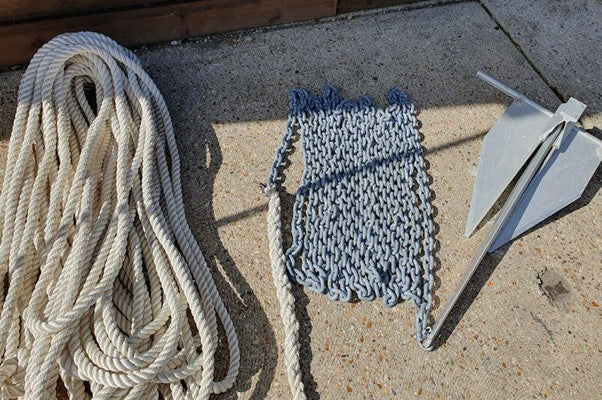
An anchor is only as effective as the system supporting it. The combination of the anchor and the chain attached as well as the rope, known as the rode, directly impacts performance.
A longer chain creates a better catenary curve, helping to keep the pull on the anchor horizontal. This improves holding power and reduces the risk of the anchor breaking free. In rough conditions, a heavier chain can provide additional stability, though it comes at the cost of increased weight and handling effort.
Anchor chain length is just as important as its weight when it comes to effective anchoring. How much chain is required will depend on a number of factors.
As a general rule, boaters aim for a scope of at least 4:1 to 5:1 (chain length to water depth) in calm conditions, increasing to 6:1 or more in rough weather to maintain a proper catenary curve. A longer anchor chain helps keep the pull on the anchor low and horizontal, significantly improving holding power and reducing the risk of dragging, particularly in deeper water or crowded anchorages.
Avoiding poor-quality anchors
Not all anchors are created equal. Poor quality copies of well known designs can significantly underperform, even if they look similar.
Inferior materials, poor welding, and inaccurate geometry can all reduce an anchor’s effectiveness. This can lead to dangerous situations, particularly in challenging conditions.
When selecting an anchor, it’s important to choose reputable brands and suppliers. Investing in a high quality anchor is a crucial step in ensuring safe anchoring.
Choosing the right anchor for your needs
Ultimately, the best anchor type depends on your boating style, the environments you visit most frequently, and your vessel’s size and weight.
For general cruising, a plough or claw anchor offers versatility and reliability. For those seeking maximum performance, new generation anchors provide superior holding power and ease of use. In specialised conditions, such as rocky seabeds, traditional designs may still be the best choice.
Many experienced boaters carry several anchors, including a primary anchor and a secondary kedge or stern anchor, to cover a range of scenarios.
Why choose Seamark Nunn for your anchoring needs?
When it comes to selecting the right anchor types and equipment, choosing a trusted supplier is just as important as choosing the right design. At Seamark Nunn, you’ll find a carefully curated range of anchors, anchor chains, and accessories from leading manufacturers, ensuring quality, reliability, and performance.
Whether you’re looking for claw anchors, delta anchors, or the latest new generation designs, their expert team can help you find the ideal solution for your boat and cruising conditions. With decades of experience in marine equipment, Seamark Nunn provides not only products but also guidance you can rely on, helping you anchor with confidence.