
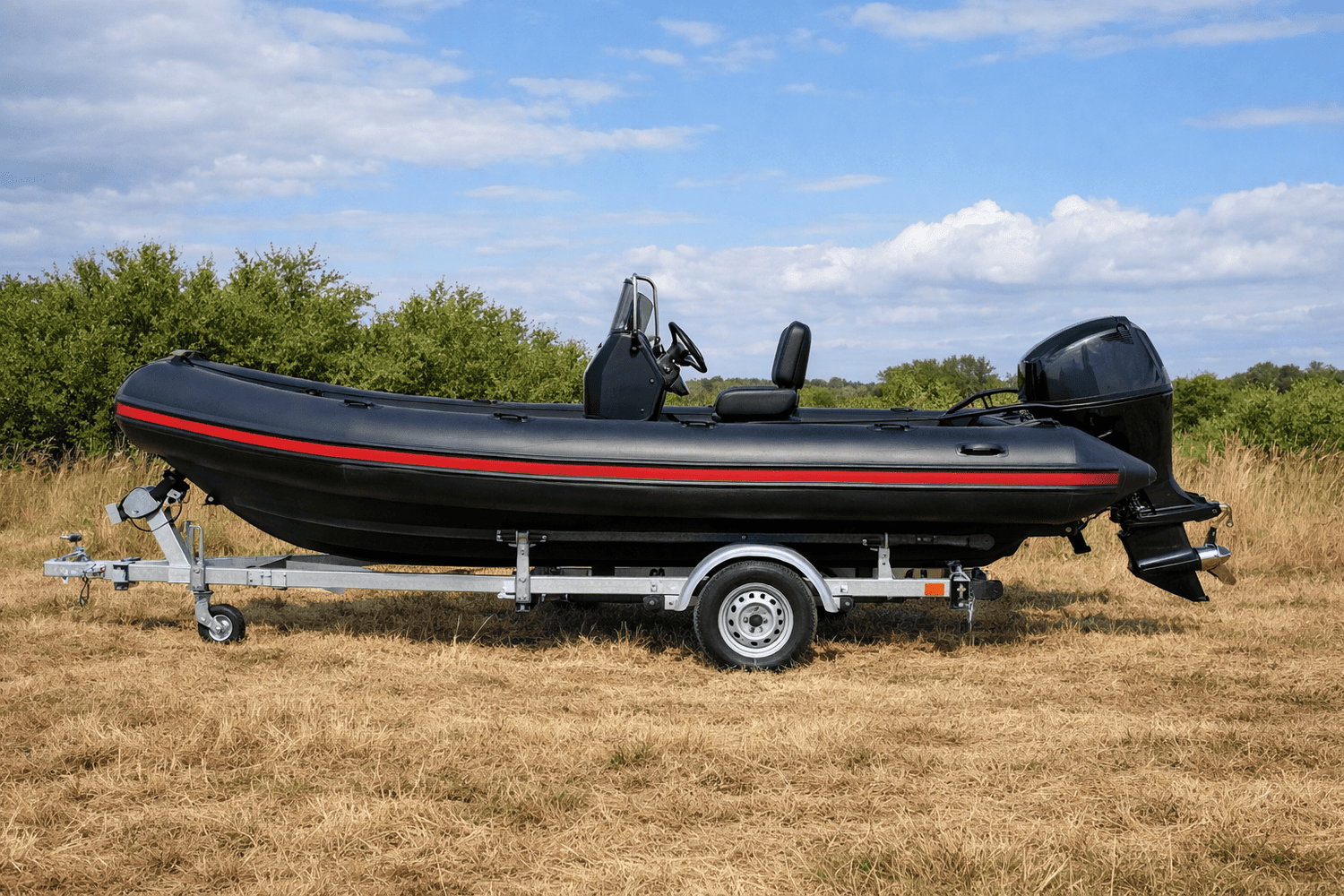
If you’ve spent any time around the water, you’ve probably noticed RIBs everywhere, zipping across harbours, acting as yacht tenders, even serving as rescue boats for emergency teams.
They’re fast, stable and incredibly capable, but what actually makes a RIB a RIB? And why have they become one of the most popular small boats in the UK?
In this guide, we’re breaking down exactly what a RIB inflatable boat is, how it works, and why so many boaters swear by them. Whether you’re new to boating or looking to upgrade, this is the perfect place to start.

So… What Is a RIB ?
A RIB, or Rigid Inflatable Boat, is exactly what its name suggests, a clever combination of a solid, shaped hull and large inflatable tubes. You may also see the term RHIB (Rigid Hulled Inflatable Boat), but it means the same thing.
At its core, RIB hulls combine two essential components:
A rigid hull
- Typically built from GRP (glass-reinforced plastic) or aluminium.
- Provides the structure, strength and precise shaping, much like most boat hulls, needed for performance, handling and durability.
Inflatable tubes (sponsons)
- The large, buoyant tubes, often referred to as the inflatable collar, run around the outside of the boat.
- Split into multiple air chambers so that if one is damaged, the others continue to provide stability and flotation.
This combination is what makes a RIB so unique. You get the speed, sharp handling and sea-keeping of a traditional hard-hulled boat, paired with the stability, buoyancy and forgiveness that inflatable tubes provide. It’s a balance that other small boats rarely achieve.
Most RIBs are powered by one or more outboard engines, and thanks to their relatively low weight, they lift onto the plane quickly and deliver impressive performance without needing huge amounts of power.
How Does a RIB Work on the Water?
One of the reasons RIBs are so popular is the way they behave on the water. Unlike heavier displacement boats that plough through the surface, a RIB is designed to rise up and skim across it once you’re underway.
The deep-V hull or semi-V hull does the first part of the job, cutting through chop and helping the boat track straight even when sea conditions aren’t perfect. As you apply more throttle, the boat's hull lifts out of the water and the boat planes, dramatically reducing drag and improving both speed and fuel efficiency.
Meanwhile, the inflatable tubes play a crucial supporting role. They add huge amounts of buoyancy, act as shock absorbers, and provide a natural fender all the way around the boat. The result is a ride that feels stable, cushioned and surprisingly confident, even when you’re pushing into heavy seas.
All of this adds up to a boat that feels:
- Sure-footed when people move around on board.
- Forgiving for newer helms who are still building confidence.
- More capable in choppy water than many similar-sized hard boats.
What Makes RIBs So Popular?
You’ll find RIBs everywhere, family beaches, sailing clubs, marinas, dive sites, even rescue services. Their popularity isn’t a coincidence; it’s down to a combination of qualities that few other small boats manage to offer at the same time.
1. Stability & Safety
- The wide beam and generous tubes make RIBs incredibly stable at rest, ideal for fishing, diving, loading kit or getting children on and off the boat.
- Their multi-chamber tubes retain buoyancy even if one section is damaged or deflates, adding a welcome layer of safety.
- The soft tubes are also far more forgiving when coming alongside pontoons or other boats, reducing knocks and scrapes.
If stability is high on your priority list, RIB-style inflatables and accessories at Seamark Nunn offer plenty of dependable options.
2. Performance & Handling
- Thanks to their lightweight construction, high-performance RIBs deliver sharp acceleration and responsive handling.
- They’re capable of impressive speeds relative to their engine size, without feeling unruly.
- A well-matched hull and outboard setup give a smooth, predictable ride, something that benefits both the crew and newer helms who are still building confidence.
3. Versatility
RIBs are genuinely multi-purpose boats, commonly used for:
- Family trips and coastal exploring
- Tenders for sailing yachts and motorboats
- Diving and fishing
- Sailing club safety duties
- Rescue, patrol and commercial work
If you need a boat that can handle everything from gentle river cruising to lively coastal runs, a RIB is an excellent all-rounder.
4. Lightweight & Trailerable
Most small to mid-size RIBs are light enough to:
Be towed comfortably behind a car
Launched and recovered from a slipway without a large vehicle or big crew
Matched with the right trailer, a RIB becomes a genuinely go-anywhere craft.
Seamark Nunn also offers a full range of RIB trailers for sale, making it easy to put together a complete, trailer-ready setup.
RIB vs Standard Inflatable Boat – What’s the Difference?
If you’re comparing options, it helps to understand how a RIB differs from a traditional soft inflatable dinghy, often referred to as a soft inflatable boat.
Standard inflatable (soft inflatable)
- Fully soft construction with inflatable tubes and a soft hull and a flexible or removable floor (slatted, air-deck or aluminium panels).
- Packs away into a bag for easy storage and transport.
- Very lightweight and compact, ideal where space is limited.
- Handling is less precise at maximum speed, and the deck feels less rigid underfoot.
RIB (Rigid Inflatable Boat)
- A solid GRP or aluminium hull RIB combined with inflatable tubes.
- Doesn’t fold, typically stored on a trailer, davits or deck chocks, just like many larger boats.
- Delivers noticeably better performance, handling and sea-keeping than most soft inflatables of the same size.
- Feels more like a “proper boat,” with a firm deck and options for consoles or seating layouts.
If portability and easy storage are your priorities, a soft inflatable is hard to beat. But if you want the handling and stability of a hard hull with the reassurance of inflatable tubes, a RIB is the natural upgrade.
Typical Sizes & Layouts of RIBs
RIBs are available in a wide variety of sizes, each suited to different types of boating.
Smaller RIB tenders (around 2.5–3.0m)
- Ideal for short trips, ship-to-shore runs and light-duty work.
Mid-size family and club RIBs (4–7m)
- Offer space for several people, gear, console steering and more powerful engines.
Large commercial / offshore RIBs (10m and above)
- Often feature cabins or specialist layouts for professional use.
Smaller RIBs typically include:
- An open deck
- Simple seating (bench or thwart)
- A tiller-steered outboard
Larger RIBs may introduce:
- Central or side consoles with wheel steering
- Jockey or bench seating
- Storage lockers
- Space for fuel tanks, electronics and safety equipment
If you’re exploring options, you’ll find a variety of RIB-style tenders and inflatables suited to everything from leisure use to more demanding trips in our shop.
Key Components of a RIBs
When you’re comparing RIBs, you’ll come across a range of technical terms. Here’s what they refer to and why they matter.
1. Hull Material
GRP (fibreglass):
- Common on many leisure RIBs, offering a smooth finish and a shaped and smooth surface, with solid strength and flexibility in hull shaping.
Aluminium:
- Lightweight, tough and highly resistant to knocks or beaching, a practical choice for frequent shore launching or general durability.
2. Tube Fabric
Most quality RIB tubes are made from one of two materials:
PVC:
- Cost-effective, lightweight and perfectly suitable for general leisure use when maintained properly.
Hypalon (CSM):
- Highly UV-resistant and more durable in demanding climates, often preferred for long-term, intensive use.
Seamark Nunn stocks cleaners and repair kits suitable for both materials, making it easy to keep your tubes in good condition.
3. Floor / Deck Type (for smaller RIBs & inflatables)
Even though full RIBs have rigid hulls, many compact inflatables use different floor systems, each offering its own benefits:
Air-deck floors:
- High-pressure inflatable decks that feel surprisingly firm underfoot while keeping weight low.
Aluminium or slatted floors:
- Strong, removable panels that add rigidity and can improve performance.
These designs are a great middle ground if you want some of the stability and feel of a RIB, but still need something that packs away neatly.
What Can You Use a RIB For?
RIBs are incredibly versatile, and their design makes them suitable for a wide range of on-the-water activities. Here are some of the most common ways they’re used:
Family Day Boat
- Perfect for coastal exploring, creek hopping or dropping anchor for a picnic.
- Easy to board from the water, making them great for swimming and water sports.
- Stable decks that give children and pets plenty of confidence moving around.
Yacht or Motorboat Tender
- Ideal for short runs between boat and shore.
- Capable of carrying passengers, provisions and gear comfortably.
- Their stability and durability make them well-suited to davits or regular boarding.
Fishing & Diving Platform
- Generous deck space for kit, coolers and dive cylinders.
- Very stable at rest, even with people moving around.
- The tubes make it simple to enter and exit the water safely.
Club Safety Boat or Coaching RIB
- Quick acceleration and agile handling allow for fast response when needed.
- Excellent visibility and control during training sessions.
- Soft tubes are gentle when manoeuvring near dinghies or assisting capsized sailors.
If you're equipping a club, school or commercial setup, Seamark Nunn offers a wide range of RIBs and inflatable accessories, from pumps and cleaners to repair kits and support equipment.
Looking After a RIB
A well-maintained RIB boat can last for many years, and the basics of caring for one are straightforward.
1. Keep It Clean
Salt, sun and general grime can shorten the life of tube fabric.
- Rinse the boat with fresh water after each trip.
- Use a purpose-made inflatable or RIB cleaner to remove scuffs, oxidation and dirt without damaging PVC or Hypalon.
Seamark Nunn carries biodegradable cleaners suitable for rubber, PVC, vinyl and GRP, making routine wash-downs easy and safe.
2. Check Pressures
- Inflate tubes to the manufacturer’s recommended pressure.
- Avoid over-inflating, particularly in hot weather when air expands.
- A pump with a reliable gauge helps keep pressures consistent, and Seamark Nunn offers several that pair well with inflatable boats.
3. Repair Small Damage Promptly
- Minor punctures or abrasions can often be fixed with simple puncture repair kits designed for PVC or Hypalon tubes.
- Make sure the adhesive and patch material match your tube fabric.
- For larger issues, or if you’re unsure, professional advice is always the safest option.
A range of repair kits is available through Seamark Nunn if you want to keep one on board.
4. Protect from UV & Weather
- Use a cover or store your RIB under shelter whenever possible.
- If it lives on a trailer, check that the boat is properly supported and draining correctly to avoid water pooling.
Why Buy Your RIB from Seamark Nunn?
Choosing the right RIB is easier when you’re dealing with people who genuinely know the boating world. Seamark Nunn is a long-established, family-run chandlery based in Felixstowe, with decades of experience helping boat owners find the kit that’s right for them.
Our reputation across East Anglia, and far beyond, comes down to expertise, reliability and a genuinely personal approach.
When you buy from Seamark Nunn, you’ll find:
- A comprehensive range of RIBs and inflatable boats, from compact tenders to larger, more capable models.
- Outboard engines to match your setup, including both petrol and electric options.
- All the accessories you might need in one place, trailers, pumps, covers, repair kits, safety equipment, electronics and more.
- In-house outboard servicing and repairs, handled by an experienced team with one of the largest servicing operations in the region.
And if you're unsure which RIB suits your needs, help is only a phone call away. Their team is known for offering straightforward, practical advice, whether you’re buying your first tender or upgrading to something more capable.
Looking for guidance or want to compare options?
The Seamark Nunn team is always happy to help: 01394 451000
Ready to Choose Your RIB?
To sum up, a RIB inflatable boat offers:
- A rigid, shaped hull combined with buoyant inflatable tubes
- Exceptional stability and safety, even in challenging conditions
- Confident handling and strong performance for leisure or practical use
- Versatility that covers everything from relaxed family trips to demanding commercial roles
So if you’ve been asking yourself “what exactly is a RIB inflatable boat, and is it right for me?”, the answer is often yes. For many boaters, a RIB is one of the most capable, reliable and confidence-inspiring small boats you can own.